Marine & Boat Hull Cleaning
Antifouling and bottom paint removal tuned to protect the gel coat — verified with a test patch before the full pass. No chemicals, no water, no sanding dust — surfaces left clean and ready for the next coating system.
The problem with traditional bottom-paint removal
Built-up antifouling paint on a fibreglass hull eventually has to come off — for inspection, blister repair, or to start over with a fresh coating system. The standard options are all bad:
- Sanding risks burning through the gel coat. One careless pass and you have an osmosis problem.
- Chemical strippers create disposal and runoff issues at the marina, and react unpredictably with multiple paint layers.
- Pressure washing drives water and contaminants into any micro-cracks in the gel coat.
- Soda blasting leaves an alkaline residue that has to be neutralized before re-coating.
Why dry ice blasting is the right answer for hulls
Dry ice pellets are softer than gel coat. Tuned correctly, they lift antifouling and primer layers without touching the gel coat underneath. Once the paint is off, the surface is dry, clean, and immediately paint-ready — no neutralizing wash, no drying time, no residue to remove.
- No gel coat damage. We tune pressure and pellet size for fibreglass and run a small test patch before committing.
- No chemical waste. CO₂ sublimates into air. The only thing on the ground is the old paint, which is collected and disposed of.
- No water on the work surface. Hull stays dry; no risk of trapping moisture under new paint.
- Marina-friendly. No runoff, no slurry, no blast-media waste — containment captures paint chips and debris before they reach the water.
- Same-day paint-ready. No drying or curing time before the next coating system.
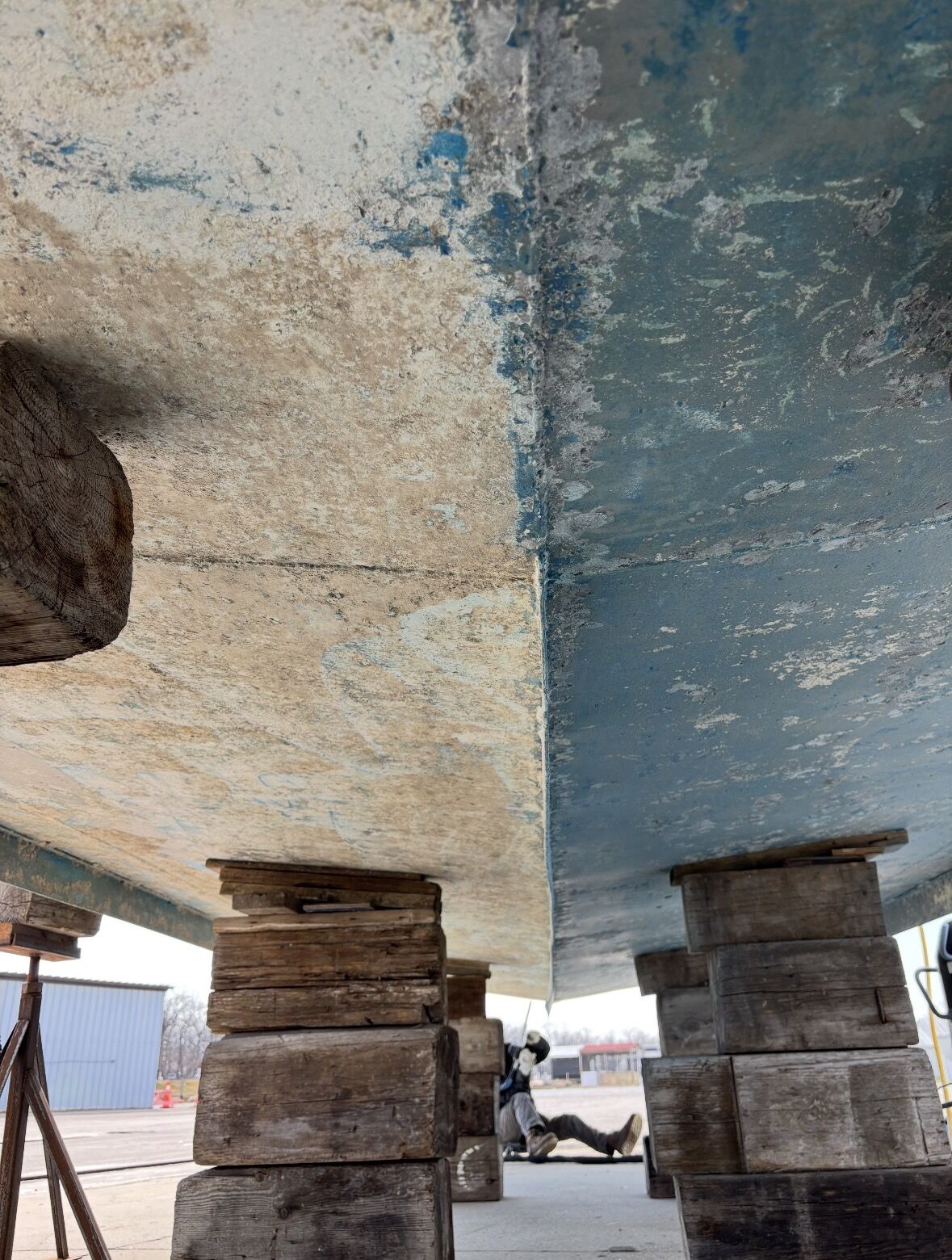
Recent work — fibreglass hull restoration
The job: A fibreglass hull with built-up antifouling paint that needed to come off cleanly before re-coating.
Our approach: Cold Jet dry ice blasting at a pressure tuned for fibreglass — strong enough to lift the antifouling, soft enough to leave the gel coat intact.
The result: Paint removed, gel coat preserved, no water on the work surface, no chemical waste to dispose of. The hull was paint-ready the same day.
Where we work
Mobile service across Southwestern Ontario marinas — Windsor/Essex, Chatham-Kent, Sarnia/Lambton, London, Leamington, and Lake St. Clair / Detroit River yards. We can come to your slip, your hard, or your storage shed.
How a typical marine hull project runs
Most hull work is scheduled when you can have the boat tied up at the dock for a half-day to two-day window. We bring the truck, compressor, and dry ice to the marina. Containment is set up around the work area to manage paint chips and debris. The crew works section by section — antifouling paint typically lifts in one pass, gel-coat prep is a lighter pressure setting. No abrasive enters the water and no haul-out is required.
Pricing
Marine hulls are typically quoted as a fixed-price per linear foot of the boat, plus mobilization. A typical recreational hull (24–35 ft) runs $60–$120/linear foot depending on antifouling layers, gel-coat condition, and access. Commercial vessels and steel hulls are quoted separately. Mobilization includes setup, containment, and equipment — every quote is “fully loaded.” See our cost guide for ranges.
FAQ
Will dry ice damage gel coat?
Not when it’s tuned for the substrate — our standard procedure. We set nozzle pressure and pellet size for gel coat and run a small test patch first, soft enough to lift antifouling without harming a sound gel coat surface. The hull is left clean and ready for sanding, fairing, or new bottom paint.
How does this compare to sanding or scraping?
Faster, with none of the fine airborne sanding dust — paint comes off in contained chips, with no run-off in the marina. A typical 28-ft hull runs 6-8 hours of dry ice vs. 1-2 days of manual sanding. And the marina doesn’t end up with antifouling chips in the water.
Do we need to be hauled out?
No. We work at the dock with the boat in the water. The only requirement is access to the hull on a slip or in a covered work area, and parking for the truck within hose distance.
Can you handle steel and aluminum hulls?
Yes. Steel and aluminum work the same way — pressure tuned to the substrate. We do recreational fibreglass, aluminum cruisers, steel commercial vessels, and dock equipment.
Request a quote
Related reading and service areas
Recent work
A fibreglass hull stripped at the dock — no haul-out, no sanding dust: