
A cross-border industrial contractor serving Sarnia’s Chemical Valley dropped off three fin fan impellers at our Wallaceburg shop. All three had come out of service carrying baked-on carbon and oil varnish across the blades, shroud and hub. The requirement was straightforward but unforgiving: strip the deposits completely, and change nothing else — no metal removed, no blade profile altered, no media left behind in the roots, and the balance condition exactly as it went in.
The situation
Fin fan and air-cooled heat exchanger impellers foul from the process side. Oil carryover bakes onto the blade surfaces under heat, and everything that passes through afterward sticks to it. The deposit builds unevenly, and that is what makes it more than a cosmetic problem: mass added out-of-plane on a rotating assembly shows up as vibration, and vibration shows up in the bearings. Airflow drops as the blade profile thickens and roughens, so the exchanger works harder for less duty.
By the time parts reach a rebuild shop, the cleaning method itself becomes the risk. Media blasting entraps abrasive in the blade roots and hub pockets — a genuine FOD problem on start-up — and removes parent metal, which puts the balance out. Chemical dipping introduces handling, disposal, flash corrosion and dry time. Hand scraping is slow, inconsistent from blade to blade, and gouges the surfaces it is trying to save.
Before: what came in
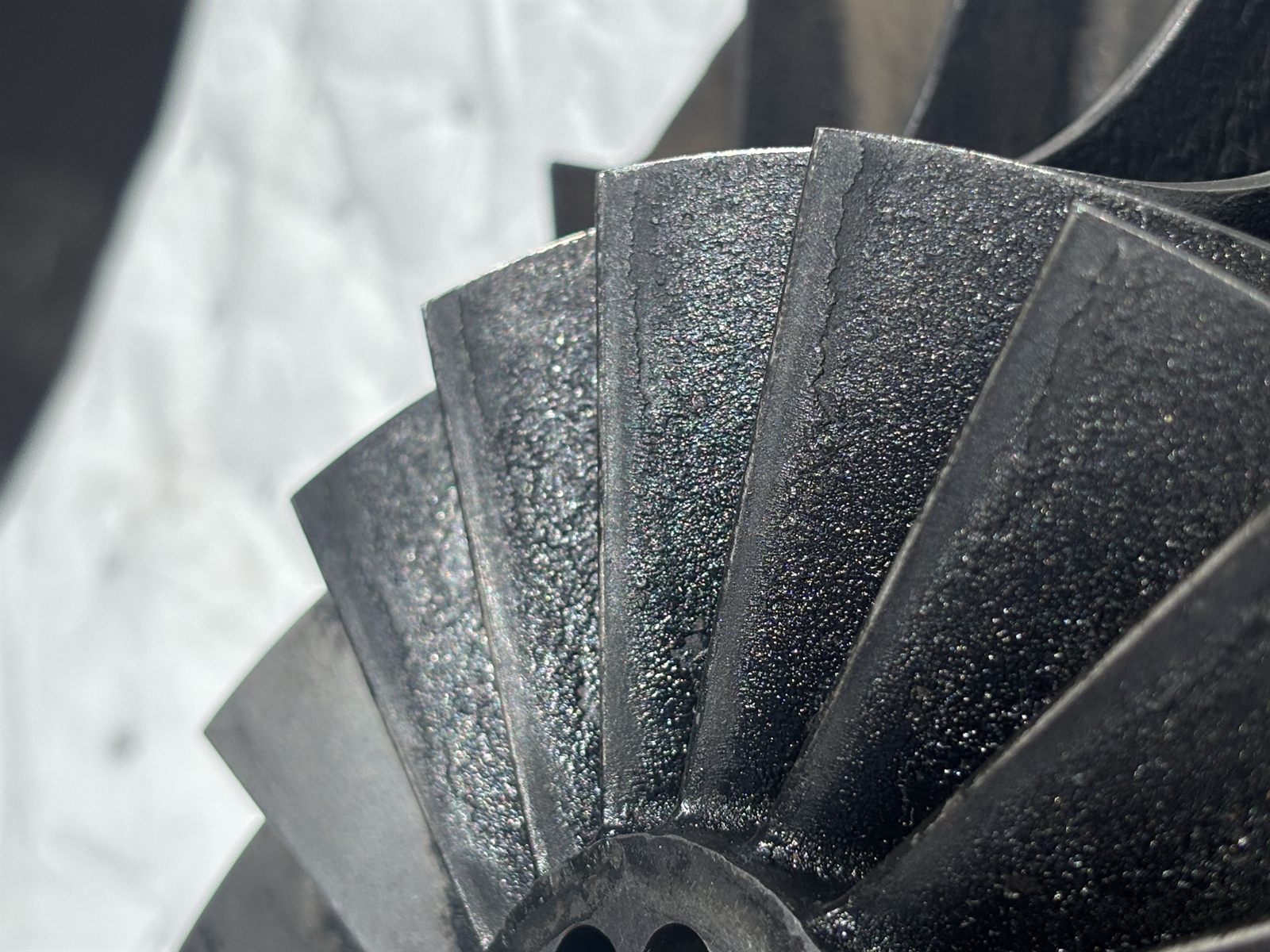
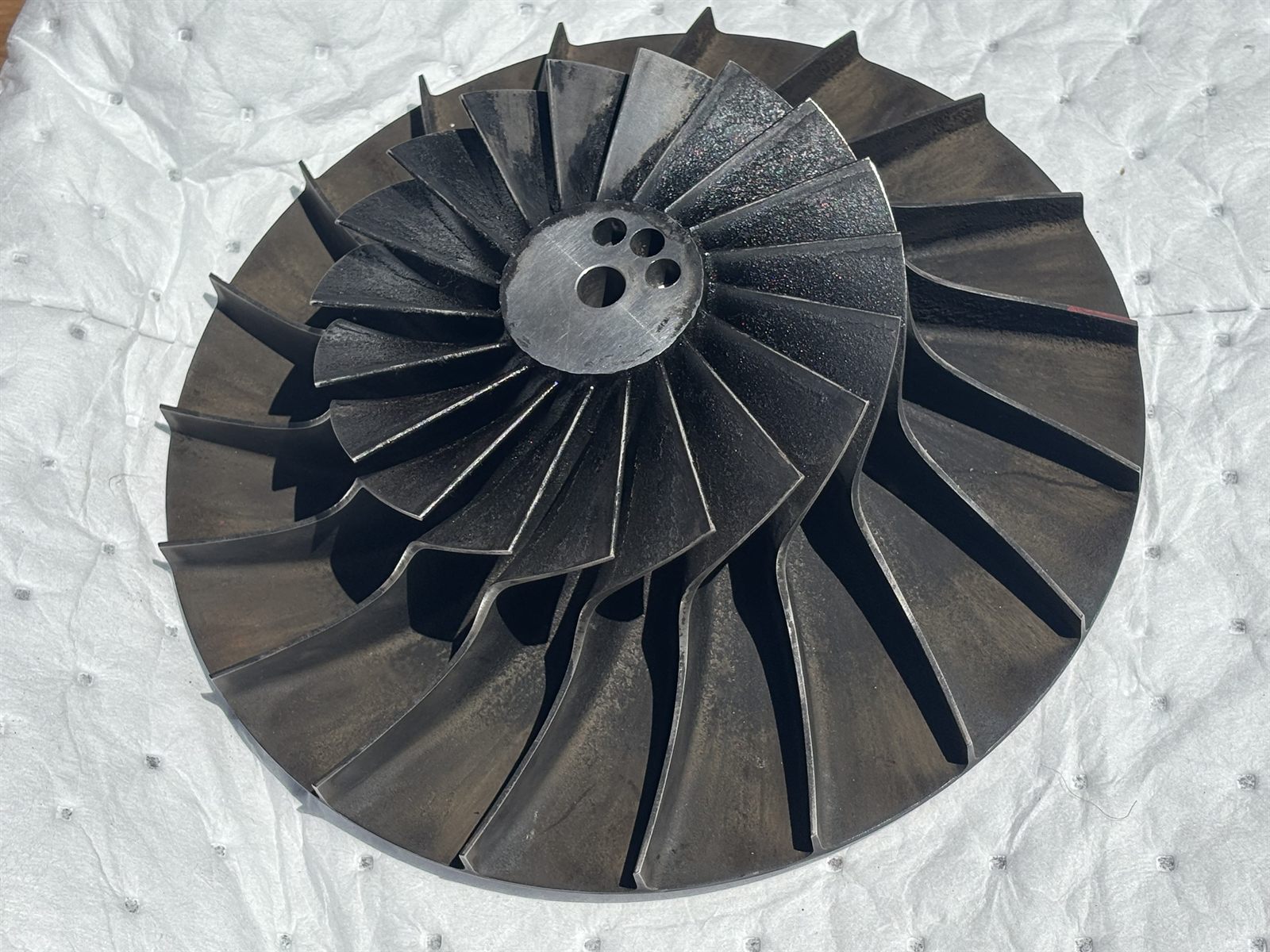
The deposits covered the blade faces, the shroud and the hub — including the mounting face and bore, where any abrasive residue left behind would go straight into the assembly on reinstallation.
The approach
Dry ice blasting removes deposits without touching the substrate. The CO2 pellet sublimates on impact, so there is no media to entrap and nothing to reclaim — the deposit itself is the only waste stream.
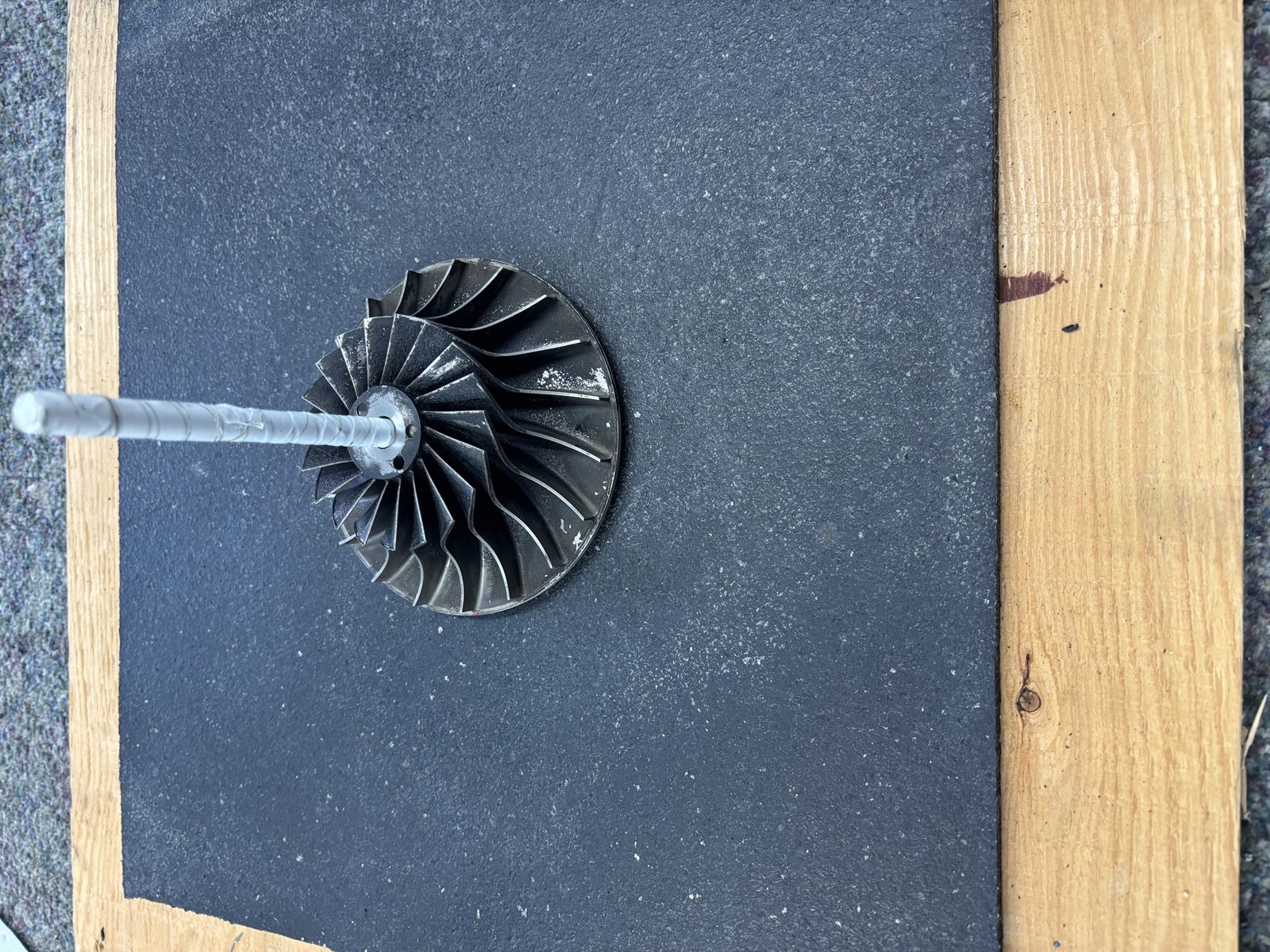
Because all three impellers shared a hub pattern, we fabricated a rotating fixture to hold them. Indexed rotation gave consistent access to every blade root at a repeatable angle and standoff — which is what produces an even finish across eighteen blades, rather than a good result on the accessible ones and a compromise on the rest. No masking was required: bores, keyways and mounting faces are unaffected by dry ice, so they were simply left alone.
The result
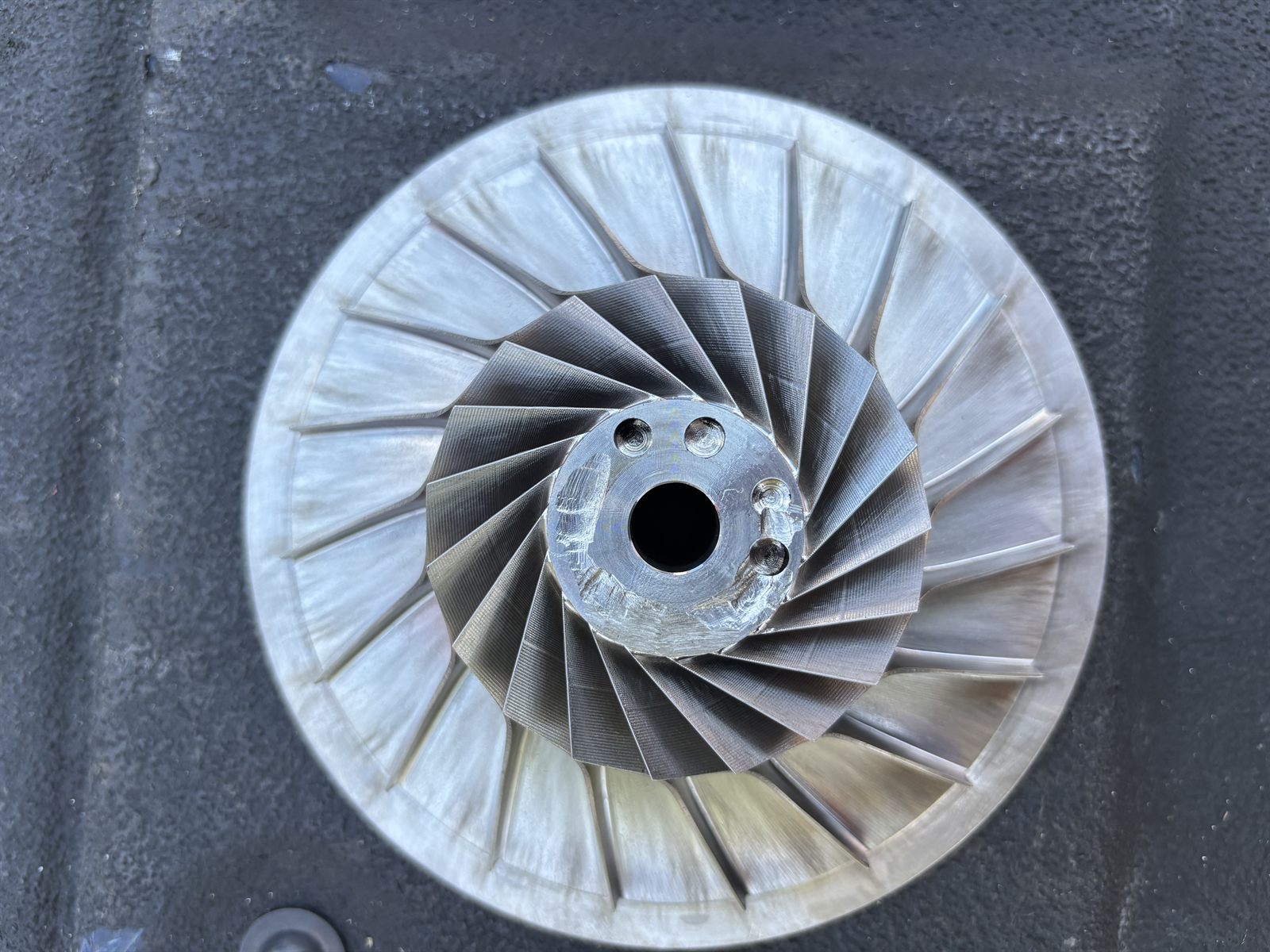
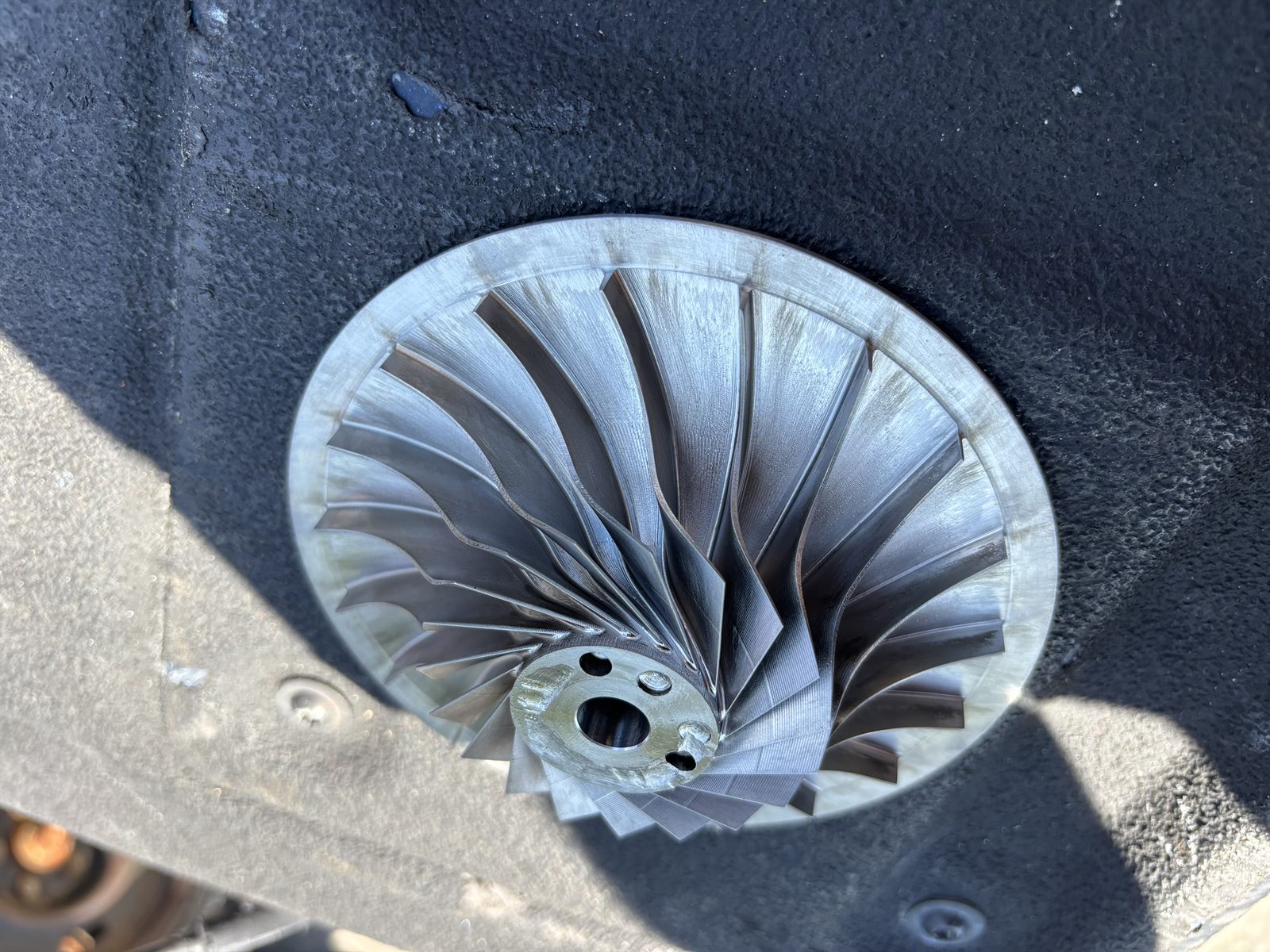
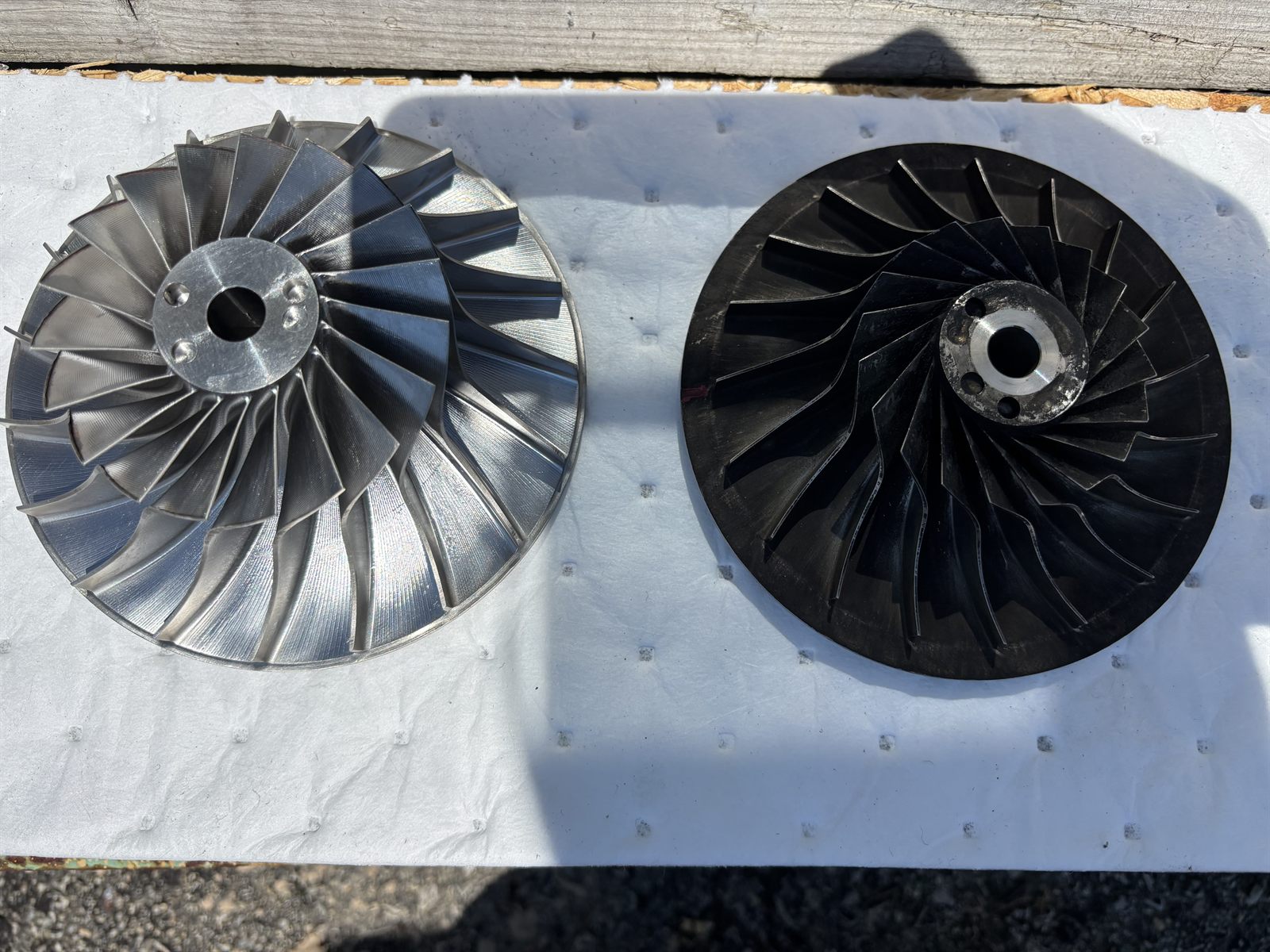
All three impellers came back to clean parent metal. No metal was removed, no dimensions changed and the balance state was untouched, so the parts went straight back to assembly with no intermediate step. Turnaround sat well inside the customer’s window, and the fixture is retained at our shop for their next batch.
Why dry ice blasting for rotating equipment
On anything that spins, the cleaning method and the mechanical integrity of the part are the same conversation. Dry ice is non-abrasive and dimensionally neutral: it lifts the deposit and leaves the parent metal where it is. There is no secondary media to find its way into a bearing housing, no chemical residue, no wash-down and no dry time. For impellers, fans, rotors and shafts, that means a part can come off the truck, get cleaned, and go directly to balancing or assembly.
Send us the parts
Not every job needs a crew on site. Impellers, fans, blowers, housings and exchanger components can be dropped off or shipped to our Wallaceburg shop, cleaned on the bench and staged for pickup — typically within three business days. Every part is photographed on intake, and your tags and job numbers stay with it from receipt to return.
Serving Southwestern Ontario
We work across Sarnia–Lambton, Windsor–Essex, Chatham-Kent and London, on site or on the bench. This is our fin fan & heat exchanger cleaning service.
Have parts that need cleaning? Text photos to 226-627-4878 or email scott@ontariodryiceblasting.com for a quote.